loader image

About

Why Least Developed Countries?

Least developed countries (LDCs) are low-income countries confronting severe structural impediments to sustainable development. They are highly vulnerable to economic and environmental challenges and have low levels of human assets. There are currently 44 countries on this list, which is reviewed every three years by the Committee for Development Policy (CDP).

Least developed countries are considered a priority in the 2030 Agenda for Sustainable Development.

TUI Care Foundation, Sustainable Development, Least developed countries, sustainable tourism, Tourism For Development Fund

Countries classified as Least developed meet the following criteria

Income

Countries with an average per capita income of below USD1,088 (2024) for inclusion, and above USD1,306 (2024) for graduation.

Human Assets

Low score on the Human Assets Index, which measures aspects of health and education outcomes, like under-five mortality rate or material mortality.

Economic and Environmental Vulnerability

High score on the Economic and Environmental Vulnerability Index, which measures remoteness or dependence on agriculture.

Tourism and Least Developed Countries

According to the United Nations, sustainable tourism has the potential to be a key driver of development in many least developed countries. The sector, with its extensive linkages to a wide range of stakeholders and activities, can contribute to economic growth, community development, intercultural dialogue and environmental conservation.

Tourism is...

1
a central driver for Least Developed Countries graduation
Throughout the past, tourism has been one of the most important factors for this, especially for small island Least Developed Countries like Cabo Verde or Mauritius.
2
a steadily growing economic sector
In pre-pandemic times, tourism accounted for 1 in 4 of all new jobs created worldwide and 10.3% of global GDP (US$9.6 trillion).
3
important for the development potential in many Least Developed Countries
The sector, with its extensive linkages to a myriad of stakeholders and activities, contributes to economic growth, community development, intercultural dialogue, environmental conservation.
4
an effective form of development cooperation
From 2010 to 2019, tourism spending in emerging and developing countries increased by 60 % – from US$336 to US$536 billion compared to US$153 billion official development aid in 2019.
5
a driver of gender equality
Women account for 60 to 70% of total tourism employment worldwide and are increasingly setting up own successful businesses.
6
supporting environmental conservation
Tourism is one of the few market-based approaches to environmental and species conservation that is essential for the survival of national parks and nature reserves in developing countries.
"Least Developed Countries have an enormous untapped tourism potential which is an important opportunity for their economic and social development. We want to put destinations in LDCs on the global tourism radar.”
Thomas Ellerbeck, TUI Care Foundation, Sustainable Development, Least developed countries, sustainable tourism, Tourism For Development Fund
Thomas Ellerbeck
Chairman of the Board of Trustees of the TUI Care Foundation
"In recent decades, tourism has become a significant development driver for many Least Developed Countries. By supporting education, nature conservation, and economic development in LDCs, the Tourism for Development Fund aligns well with UN Tourism's mission to advance tourism as a powerful tool for sustainable and regenerative development."
TUI Care Foundation, Sustainable Development, Least developed countries, sustainable tourism, Tourism For Development Fund
Zoritsa Urosevic
Executive Director of UN Tourism

Tourism For Development Fund Projects​

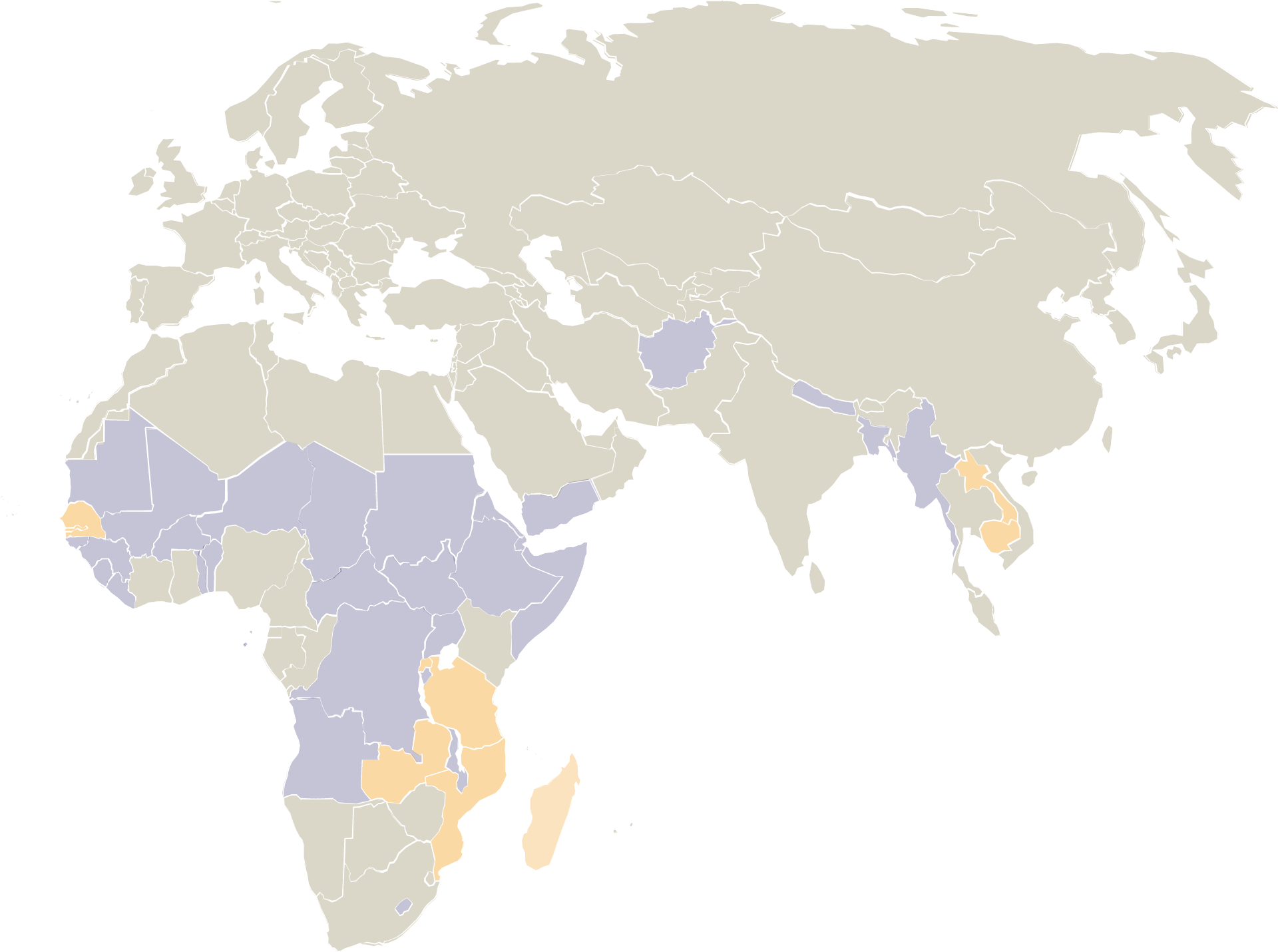
Least Developed Countries
TUI Care Foundation Projects in Least Developed Countries

Global Programmes:
Tourism For Development Fund Projects​
Senegal The Gambia Zambia Rwanda Tanzania Mozambique Laos Cambodia Madagascar

Senegal

TUI Care Foundation, Sustainable Development, Least developed countries, sustainable tourism, Tourism For Development Fund

US$ 2,400 million contribution of tourism to GDP (7.5% of total); 372,100 million tourism jobs (7.1% of total)

Source: World Travel &Tourism Council 2024 Annual Research, Data for 2023 year

Running Projects:

The Gambia

TUI Care Foundation, Sustainable Development, Least developed countries, sustainable tourism, Tourism For Development Fund

US$ 334.8 million contribution of tourism to GDP (14.4% of total), 126.7 million tourism jobs (13.5% of total)

Source: World Travel &Tourism Council 2024 Annual Research, Data for 2023 year

Running Projects:

Zambia

TUI Care Foundation, Sustainable Development, Least developed countries, sustainable tourism, Tourism For Development Fund

US$ 1,700 million contribution of tourism to GDP (6.2% of total); 446,000 tourism jobs (6.7% of total)

Source: World Travel &Tourism Council 2024 Annual Research, Data for 2023 year

Running Projects:

Rwanda

TUI Care Foundation, Sustainable Development, Least developed countries, sustainable tourism, Tourism For Development Fund

US$ 1,400 million contribution of tourism to GDP (9.2% of total); 323,600 tourism jobs (7.8% of total)

Source: World Travel &Tourism Council 2024 Annual Research, Data for 2023 year

Running Projects:

Tanzania

TUI Care Foundation, Sustainable Development, Least developed countries, sustainable tourism, Tourism For Development Fund

US$ 7,800 million contribution of tourism to GDP (9.5% of total); 1.42 million tourism jobs (5.7% of total)

Source: World Travel &Tourism Council 2024 Annual Research, Data for 2023 year

Running Projects:

Mozambique

TUI Care Foundation, Sustainable Development, Least developed countries, sustainable tourism, Tourism For Development Fund

US$ 1,200 million contribution of tourism to GDP (5.1% of total); 670,000 tourism jobs (4.7% of total)

Source: World Travel &Tourism Council 2024 Annual Research, Data for 2023 year

Running Projects:

Laos

TUI Care Foundation, Sustainable Development, Least developed countries, sustainable tourism, Tourism For Development Fund

US$ 1,200 million contribution of tourism to GDP (6.5% of total); 320,500 tourism jobs (16.5% of total)

Source: World Travel &Tourism Council 2024 Annual Research, Data for 2023 year

Running Projects:

Cambodia

TUI Care Foundation, Sustainable Development, Least developed countries, sustainable tourism, Tourism For Development Fund

US$ 5,400 million contribution of tourism to GDP (16.3% of total); 2.28 million tourism jobs (23.7% of total)

Source: World Travel &Tourism Council 2024 Annual Research, Data for 2023 year

Running Projects:

Madagascar

US$ 1,600 million contribution of tourism to GDP (10.1 % of total); 0.83 million tourism jobs (5.3 % of total)

Source: World Travel &Tourism Council 2024 Annual Research, Data for 2023 year

Running Projects:

  • TUI Forest Madagascar (coming soon)
TUI Care Foundation Logo, TUI Care Foundation, Sustainable Development, Least developed countries, sustainable tourism, Tourism For Development Fund

About the TUI Care Foundation

Building on the potential of tourism as a force for good, the TUI Care Foundation supports and initiates projects, which create new opportunities and contribute to thriving communities in tourism destinations all over the world. Connecting holidaymakers to good causes, it supports education and training opportunities for young people; drives the protection of natural habitats and the marine environment; and helps local communities to thrive sustainably and benefit from tourism. The TUI Care Foundation builds on strong partnerships with local and international organisations to create meaningful and long-lasting impact. The independent charitable organisation was founded by TUI, one of the world’s leading tourism businesses, and is based in the Netherlands.

UN Tourism Logo, TUI Care Foundation, Sustainable Development, Least developed countries, sustainable tourism, Tourism For Development Fund

About UN Tourism

The World Tourism Organization ( UN Tourism ), a United Nations specialized agency, is the leading international organization with the decisive and central role in promoting the development of responsible, sustainable and universally accessible tourism. It serves as a global forum for tourism policy issues and a practical source of tourism know-how. Its membership includes 160 countries, 6 territories, 2 permanent observers and over 500 Affiliate Members.